 Skip to content



Key Takeaways
- A properly sized cold-climate mini split can serve as the primary heat source for a Montana cabin down to roughly minus 13°F to minus 22°F, depending on the model.
- Off-grid mini split heating in the Billings area requires a combined approach: cold-climate equipment, an oversized solar array, a lithium battery bank, and a backup heat source (almost always a wood stove or propane heater).
- A typical 12,000 BTU mini split draws 600-1,200 watts in steady operation and consumes roughly 4-8 kWh per day during active heating, climbing higher in subzero weather.
- December and January solar production in Billings drops to about 30-40% of summer output, which is exactly when heating loads peak. This mismatch is the central design challenge.
- Mini splits should not be treated as a single-source solution for Montana cabins. Hybrid systems with wood, propane, or a small generator deliver reliable comfort at a workable cost.
Can a Mini Split Realistically Heat an Off-Grid Cabin Near Billings?
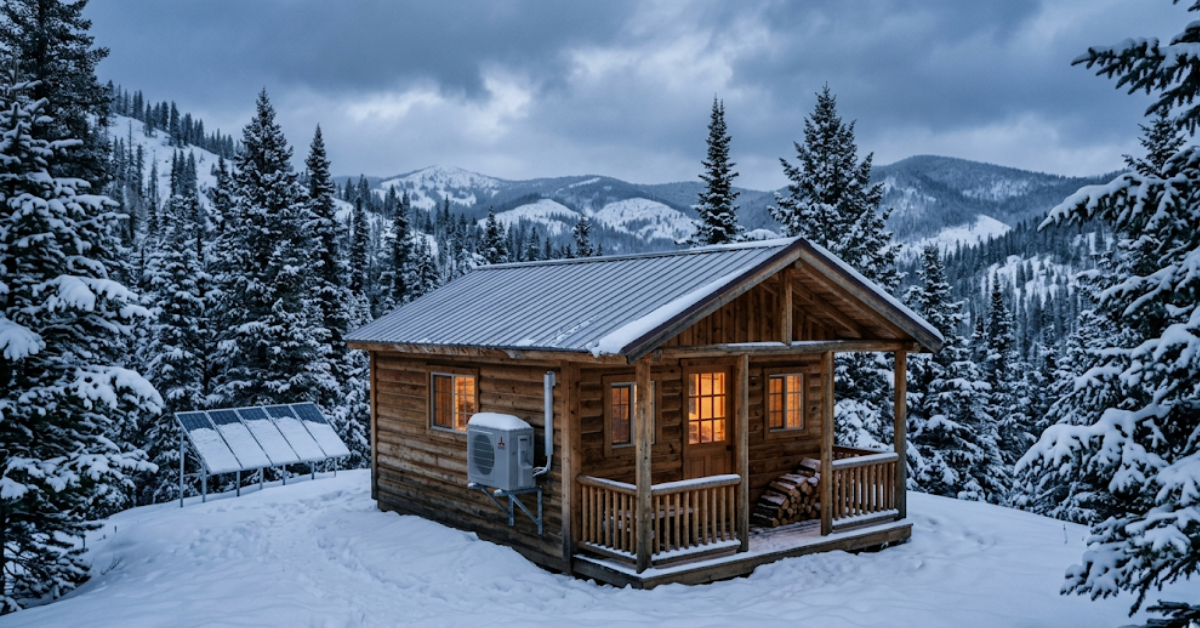
Yes, but only with the right equipment and a hybrid power and heating plan. A cold-climate mini split heat pump can serve as the primary heat source for a well-insulated cabin in the Billings region during most of the heating season, with a wood stove or propane heater handling the coldest stretches. The combination works because modern cold-climate units retain meaningful capacity well below zero, and because a smaller, more efficient electric load is easier to support with solar and batteries than electric resistance heat would be.
Billings sits in DOE Climate Zone 6 with roughly 5,775 heating degree days per year and overnight lows that routinely drop into the negatives in January and February. A cabin pulled off-grid here cannot rely on equipment that quits at 20°F. The right starting point is a heat pump rated for low-ambient operation, paired with a solar/battery system sized for the winter shortfall, not the summer surplus.
If the problem goes past a quick homeowner check, Platinum HVAC LLC provides ductless heating installation in Billings with same-day appointments across the Billings area.
Which Mini Splits Work for Off-Grid Montana Cabins?
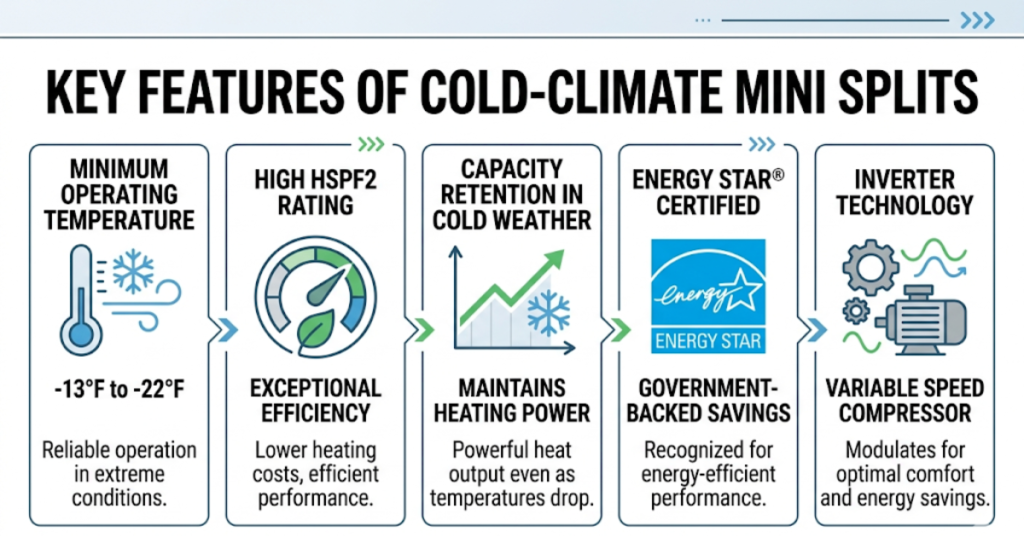
The minimum operating temperature on the data plate matters more than any other spec. Standard mini splits often shut down or lose most capacity once the outdoor temperature drops below 20°F. Cold-climate models hold useful output much further down the scale. Per the U.S. Department of Energy, cold-climate heat pumps can deliver high-efficiency heating in freezing temperatures and meaningfully reduce annual heating costs compared to electric resistance.
Look for the following specifications on any unit you consider:
- Minimum operating temperature of minus 13°F or lower (some Mitsubishi Hyper-Heat, Daikin Aurora, Gree Sapphire/Ultra, and Carrier Greenspeed models reach minus 22°F or beyond).
- HSPF2 rating of 9.0 or higher (the federal minimum for ductless heat pumps is 7.5 HSPF2).
- Capacity retention at 5°F, ideally 90-100% of rated capacity. Cold-climate units publish this number; standard units usually do not.
- ENERGY STAR cold-climate certification or listing in the Northeast Energy Efficiency Partnerships (NEEP) cold-climate heat pump database.
Inverter-driven variable-speed compressors are non-negotiable for off-grid use. They modulate output to match the load and avoid the high-amperage starting surges that wreck a battery bank.

How Much Solar and Battery Capacity Does an Off-Grid Cabin Need?
This is where most off-grid cabin plans break down. A 12,000 BTU cold-climate mini split typically draws 600-1,200 watts in steady operation. In a Montana cold snap, that climbs to 1,500-2,000 watts as the unit ramps up. Daily consumption during active heating runs 4-8 kWh in mild weather and 10-15 kWh or more when it is below zero outside.
A practical sizing rule for a Billings-area off-grid cabin running a single mini split through winter:
- Solar array: 4-6 kW minimum, oriented for winter sun (steeper tilt, ideally 50-60 degrees), with east and west panels added if possible to extend daily harvest.
- Battery bank: 15-25 kWh of usable lithium iron phosphate (LiFePO4) capacity. Lead-acid is technically possible but cuts usable capacity roughly in half and degrades fast in cold storage.
- Inverter: Minimum 4,000-5,000 watts continuous, with surge capacity for compressor starts. Pure sine wave only.
- Backup generator: A small propane or dual-fuel generator (3-5 kW) for cloudy multi-day stretches.
Winter sun is the constraint. According to NREL’s PVWatts data, a south-facing array near Billings produces about 6 kWh per installed kW per day in June, but only about 2.5 kWh per installed kW per day in December. Sizing for the December low, not the summer average, is the only honest way to plan an off-grid cabin in Climate Zone 6.
For homeowners who also want professional guidance on equipment selection, mini split installation in Billings covers the heat-pump side of the build, even if the electrical and solar work is handled by a separate contractor.
What Backup Heat Does an Off-Grid Cabin Need?
Almost every successful off-grid cabin in Montana runs hybrid heat. There are three reasons a backup source is essential:
- Cold-snap capacity. Even a minus 22°F-rated mini split delivers reduced output at minus 30°F, which Billings has recorded historically. Backup heat covers the gap.
- Multi-day cloud cover. When solar production drops below the daily heating load for three or four consecutive days, batteries deplete. Wood or propane bridges the shortfall.
- Equipment failure. A cabin 30 miles from town with a single failed mini split in January is a serious problem. A redundant heat source is a safety system.
Common backup options for Montana cabins:
- EPA-certified wood stove. Free fuel if you cut your own, no electricity required, and a clean primary backup. Requires a code-compliant chimney, fire-resistant clearance, and yearly cleaning.
- Direct-vent propane wall heater. Runs on a small amount of battery power for ignition (or a thermopile model that needs no electricity), with a 250-500 gallon tank that can hold a full winter’s reserve.
- Pellet stove. Cleaner than wood, but requires a small constant electric load for the auger and exhaust fan.
Most cabin designs we see that actually function through Montana winters use a wood stove as the primary backup with a propane wall heater as the secondary layer. The mini split handles spring, fall, and shoulder-season heating while keeping the wood pile from being depleted by November.

How Should a Mini Split Be Installed for Off-Grid Cabin Use?
Installation details that matter more in off-grid use than in normal homes:
- Mount the outdoor unit at least 18 inches above expected snow depth, on a wall bracket or elevated stand. Drifts at cabin elevations can bury a ground-mounted unit completely.
- Install a base pan heater on the outdoor unit if the manufacturer offers one. This prevents ice buildup in the drain pan during long cold runs and protects the coil during defrost.
- Plan defrost cycles into the energy budget. A unit running in deep cold reverses briefly every 30-90 minutes to melt frost off the outdoor coil. During this window, indoor heat output drops and a small electric resistance strip (in some heads) may engage. This is normal but consumes extra battery power.
- Use a single zone for primary heat. Multi-zone systems are less efficient and harder to keep running on a battery bank than a single 12,000-18,000 BTU outdoor unit feeding one well-placed indoor head in an open floor plan.
- Insulate the cabin first. Every dollar spent on R-value, air sealing, and high-performance windows reduces the load and lowers solar/battery requirements. The cheapest watts are the ones you do not need.
For homeowners weighing the broader heat-pump category, professional heat pump installation in Billings covers full sizing, refrigerant charging, and commissioning, all of which matter even more in cold-climate applications.
What Are the Cost Trade-Offs?
Honest numbers for a cabin near Billings:
- A quality cold-climate mini split (single zone, 12,000-18,000 BTU): $4,500 to $8,000 installed.
- A 5 kW off-grid solar array with charge controller and racking: $10,000 to $18,000.
- A 20 kWh LiFePO4 battery bank with hybrid inverter: $12,000 to $25,000.
- An EPA wood stove with chimney: $2,500 to $6,000 installed.
- Backup propane wall heater and tank rental: $1,500 to $4,000.
A complete off-grid heating and power package therefore typically lands in the $30,000 to $60,000 range. Federal tax credits (the 30% Residential Clean Energy Credit for solar and battery storage, plus the 25C credit of up to $2,000 for qualifying heat pumps) recover a meaningful portion of that cost.
For full background on how ductless systems perform compared to alternatives, the discussion of the pros and cons of ductless heating and cooling is worth reading before committing to a specific configuration.
Schedule a Cabin Mini Split Consultation with Platinum HVAC
Off-grid cabin heating in Montana is solvable, but it is not a single-product problem. Getting it right means picking a heat pump that actually performs at minus 20°F, sizing a solar and battery system for December (not July), and keeping a wood stove or propane heater ready for the worst weeks of winter. Skip any one of those layers and the system disappoints exactly when you need it.
The licensed technicians at Platinum HVAC handle cold-climate mini split installations across Billings and the surrounding rural communities, including Lockwood, Park City, Pryor, and cabin properties further out. We can help you size the heat-pump side of the build, advise on backup heat options, and coordinate with your solar contractor so the equipment matches the available power. Contact our team today to schedule a site assessment for your cabin project.
Need a Billings HVAC technician today?
Platinum HVAC LLC is a family-owned, EPA-certified team serving Billings and Yellowstone County. We handle ductless heating installation in Billings, 24/7 emergency calls, and financing on new systems.
Call (406) 671-8446 or request service online.
Platinum HVAC LLC, 1478 S 30th St, Billings, MT 59102
Related guides