 Skip to content




Key Takeaways
- Use the $5,000 rule: Multiply your AC’s age by the repair cost. If the result exceeds $5,000, replacement typically offers better long-term value.
- Apply the 50% threshold: When repair costs exceed 50% of a new unit’s price, investing in replacement makes more financial sense.
- Watch the 10-15 year mark: According to ENERGY STAR, the average AC lifespan is 10-15 years, and units older than 10 years should be evaluated for replacement.
- Consider efficiency gains: Replacing an AC unit that’s 10+ years old can save 20-40% on cooling costs with a modern, high-efficiency system.
- Factor in refrigerant type: If your system uses R-22 (Freon), replacement is strongly recommended since this refrigerant was phased out in 2020.
Replace your AC unit when repair costs multiplied by the system’s age exceed $5,000, or when repairs cost more than 50% of a new unit’s price. Most air conditioners last 10-15 years, and units approaching this age with frequent breakdowns, rising energy bills, or R-22 refrigerant dependency are strong candidates for replacement rather than continued repairs.
Making the repair vs replacement decision requires balancing immediate costs against long-term value. A $400 repair on a 5-year-old system is usually worthwhile, but that same repair on a 14-year-old unit may simply delay an inevitable replacement while draining your budget. Understanding the key decision factors helps Billings homeowners make confident, cost-effective choices.
How Do You Know When It’s Time to Replace Your AC Unit?
Two industry-standard rules help homeowners evaluate whether to repair or replace their air conditioning system. These calculations provide objective guidance for what can feel like an overwhelming decision.
The $5,000 Rule Explained
The $5,000 rule offers a straightforward formula: multiply your AC unit’s age by the estimated repair cost. If the result exceeds $5,000, replacement generally provides better value. For example, a 12-year-old system needing a $500 repair equals $6,000, suggesting replacement is the smarter investment. However, a 6-year-old unit with the same repair equals only $3,000, making the repair worthwhile.
The 50% Repair Cost Rule
According to HVAC industry guidelines, if repair costs exceed 50% of a new system’s price, replacement becomes the more cost-effective option. With new AC installations typically ranging from $4,000 to $8,000, any single repair approaching $2,000-$4,000 warrants serious consideration of full replacement instead.
What Are the Warning Signs You Need a New AC Unit?
Several indicators suggest your air conditioner is nearing the end of its serviceable life. Recognizing these warning signs early helps you plan and budget for replacement before an emergency breakdown occurs.
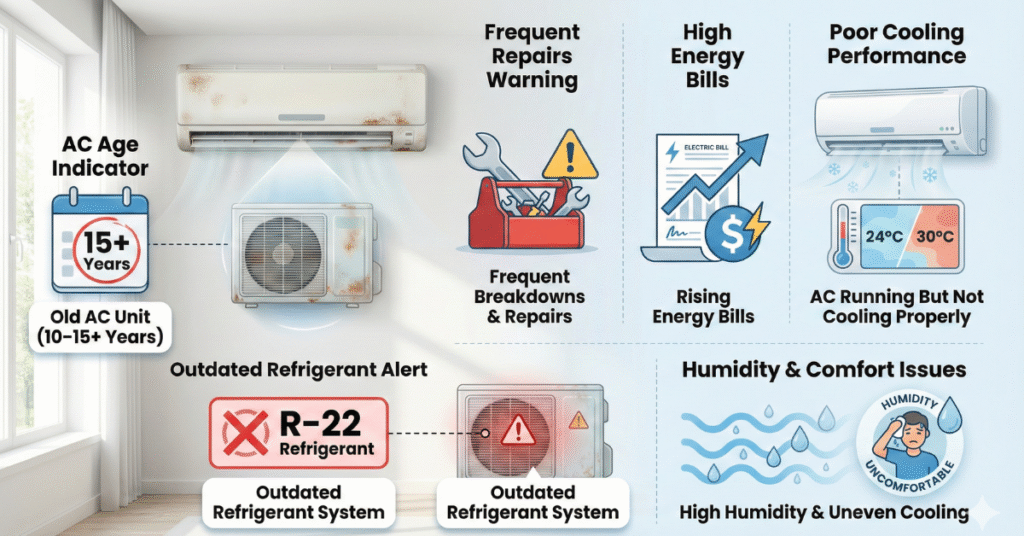
Age beyond 10-15 years: The U.S. Department of Energy reports that air conditioning units have an average lifespan of 15-20 years with proper maintenance. However, efficiency declines significantly after 10 years, and units older than 15 years face increasing repair frequency and parts availability issues.
Frequent breakdowns: If your system requires multiple repairs each cooling season, those costs add up quickly. Repeated service calls indicate underlying component degradation that will only worsen over time.
Rising energy bills: Older AC units lose efficiency gradually. If your cooling costs have increased noticeably without changes in usage habits, your system may be working harder to produce the same results. When your AC is running but not cooling effectively, inefficiency is often the culprit.
R-22 refrigerant dependency: The EPA banned production and import of R-22 (Freon) in January 2020. If your system uses this refrigerant, servicing becomes increasingly expensive due to limited supply. Replacement with a modern system using approved refrigerants like R-410A or R-454B is strongly recommended.
Inconsistent cooling and humidity issues: Your AC should maintain consistent temperatures and remove humidity effectively. Uneven cooling, hot spots, or excessive indoor humidity indicate declining system performance that repairs may not fully resolve.
Repair vs Replace AC Cost: Breaking Down the Numbers
Understanding typical costs helps frame your repair vs replacement decision with realistic expectations.
Average AC repair costs range from $125 to $600 for common issues like capacitor replacement, thermostat fixes, or refrigerant recharges, according to Forbes Home. More complex repairs involving compressors or refrigerant lines can reach $1,000-$2,500.
AC replacement costs for central air systems typically fall between $4,000 and $8,000 including installation. Premium high-efficiency units with advanced features may cost more but deliver greater long-term energy savings.
| Scenario | Repair Cost | System Age | $5,000 Rule Result | Recommendation |
| Capacitor failure | $300 | 5 years | $1,500 | Repair |
| Compressor issue | $1,200 | 8 years | $9,600 | Replace |
| Refrigerant leak | $600 | 12 years | $7,200 | Replace |
| Fan motor replacement | $450 | 6 years | $2,700 | Repair |
How Does Climate Affect Your AC Replacement Decision in Montana?
Billings homeowners face unique climate considerations that impact AC system longevity and replacement timing.
Summer temperatures in Billings regularly reach 85-90°F during July and August, with occasional spikes approaching 100°F. While Montana’s cooling season is shorter than southern states, the intensity of summer heat places significant demand on air conditioning equipment during peak months.
The region’s extreme temperature swings between seasons create additional stress on HVAC components. Systems cycle between extended dormancy in winter and heavy summer use, which can accelerate wear on compressors, capacitors, and electrical components.
Montana’s relatively dry summer climate (humidity drops to around 40% in August) means your AC handles less moisture removal than systems in humid regions. However, this doesn’t extend equipment life significantly since the cooling load remains substantial during hot spells.
For trusted AC repair in Billings or replacement evaluation, working with a local HVAC professional who understands regional climate demands ensures you receive appropriate recommendations.
What SEER Rating Should You Look for in a New AC Unit?
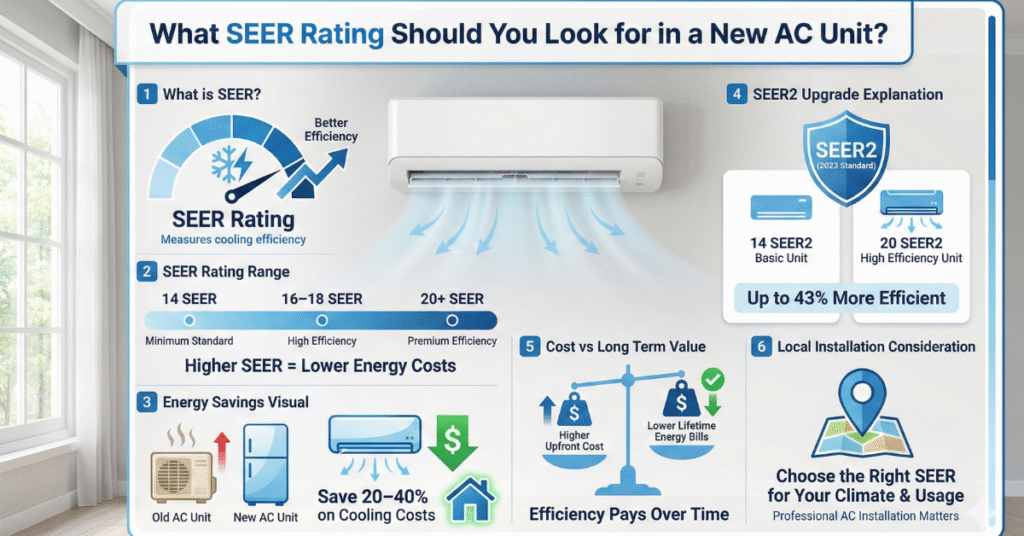
SEER (Seasonal Energy Efficiency Ratio) measures how efficiently an air conditioner converts electricity into cooling. Higher SEER ratings indicate greater efficiency and lower operating costs.
Modern AC units range from 14 SEER (minimum standard) to 20+ SEER for premium models. According to American Standard, replacing an AC unit that’s 10 or more years old can save 20-40% on cooling costs annually with a properly sized, high-efficiency replacement.
As of 2023, new efficiency standards (SEER2) provide more accurate real-world performance ratings. A 20 SEER2 unit operates approximately 43% more efficiently than a basic 14 SEER2 system. While higher-efficiency units cost more upfront, the energy savings often offset the difference over the system’s lifespan.
For professional AC installation in Billings, selecting the right SEER rating involves balancing upfront costs, expected usage, and long-term savings goals.
Should You Repair or Replace? A Quick Decision Checklist
Use this checklist to guide your repair vs replacement decision:
- Calculate the $5,000 rule (age × repair cost). Result over $5,000? Consider replacement.
- Compare repair cost to 50% of new unit price. Repair exceeds this threshold? Replacement likely makes more sense.
- Check your system’s age. Over 15 years? Replacement is typically recommended regardless of repair cost.
- Identify your refrigerant type. R-22 system? Replacement is strongly advised.
- Count recent repairs. Multiple service calls in the past two years? Replacement prevents ongoing expenses.
- Evaluate comfort levels. Inconsistent cooling or humidity problems? A new system resolves these issues.
Regular seasonal AC tune-ups help extend system life and catch developing problems early, but every AC eventually reaches the point where replacement delivers better value than continued repairs.
Ready for a Professional Assessment?
Making the repair vs replacement decision is easier with expert guidance. A professional evaluation examines your system’s current condition, efficiency, and remaining lifespan to provide honest recommendations tailored to your situation.
Platinum HVAC offers comprehensive AC inspections and replacement evaluations for Billings homeowners. Our licensed technicians assess your equipment objectively and explain your options clearly, helping you make a confident decision that fits your budget and comfort needs.
Schedule a professional AC inspection today to get a clear picture of your system’s condition and the best path forward. For urgent situations, our emergency HVAC service team is available when you need immediate assistance.
Contact Platinum HVAC to schedule your repair vs replacement evaluation.