 Skip to content




Key Takeaways
- Static pressure is the resistance your HVAC system fights against to push air through your ducts
- Uneven room temperatures are one of the clearest signs of a static pressure imbalance
- Most residential systems are designed to operate between 0.5 and 0.8 inches of water column (in. w.c.)
- According to industry data, the average HVAC system delivers less than 60% of its rated capacity due to duct-related issues
- A licensed technician uses a manometer and test ports to pinpoint exactly where airflow resistance is occurring
- Fixing static pressure problems in Billings homes can restore comfort, lower energy bills, and extend equipment life
If your home has rooms that never seem to reach the right temperature no matter how long your HVAC runs, static pressure is likely the reason. Static pressure is the resistance inside your duct system that your heating and cooling equipment must overcome to circulate air. When that resistance is too high or too low, conditioned air cannot reach every room evenly, leaving some spaces hot, cold, or stuffy.
What Is Static Pressure in Your HVAC System?
Static pressure in an HVAC system refers to the resistance that air encounters as it moves through your ductwork. Think of it the way you think about blood pressure in the human body. Your heart has to push against that pressure with every beat. Your HVAC blower motor does the same thing every time your system runs.
When static pressure is balanced, air flows freely and your home reaches a consistent, comfortable temperature from room to room. When it is too high, the blower motor strains, airflow weakens, and certain areas of your home get shortchanged on conditioned air. When it is too low, air moves without enough control, which can cause its own set of delivery problems.
Expert Insight: “Static pressure is the blood pressure of your HVAC system. If it’s too high, something is restricting the airflow. If it’s too low, you might not be moving enough air at all. Balanced static pressure equals proper airflow equals a comfortable home.” – Service Technician Team, Northwest HVAC Service, Vancouver, WA (25+ years residential HVAC experience)
Static Pressure vs. Normal Airflow
There are actually two types of pressure at work inside your duct system. Static pressure is the resistance of air pushing against the duct walls while it is relatively still. Dynamic pressure is the force created by the air actively moving. Together, these two measurements shape how efficiently your HVAC system delivers conditioned air to every room in your home.
Most homeowners only notice something is wrong when a bedroom or living area feels noticeably warmer or cooler than the rest of the house. That temperature difference is the visible result of an invisible airflow problem happening inside the ductwork.
What Does a Healthy Reading Look Like?
Static pressure is measured in inches of water column, often written as “in. w.c.” or “in. WC.” This unit traces back to the earliest manometers, which used a column of water to reflect pressure levels.
According to Lennox, one of the leading HVAC manufacturers, most residential systems are designed to operate between 0.5 and 0.8 in. w.c. Readings above that range signal an airflow restriction that needs professional attention. Industry testing guidelines from Fieldpiece, a respected HVAC diagnostic equipment manufacturer, confirm that a typical residential system runs most efficiently at or below 0.5 in. w.c.
| Static Pressure Reading | What It Means |
| Below 0.5 in. w.c. | Ideal operating range |
| 0.5 to 0.8 in. w.c. | Acceptable, monitor closely |
| Above 0.8 in. w.c. | High pressure – professional evaluation recommended |
| Very low (near zero) | Possible duct leaks or undersized returns |
If the problem goes past a quick homeowner check, Platinum HVAC LLC provides HVAC diagnostics in Billings with same-day appointments across the Billings area.
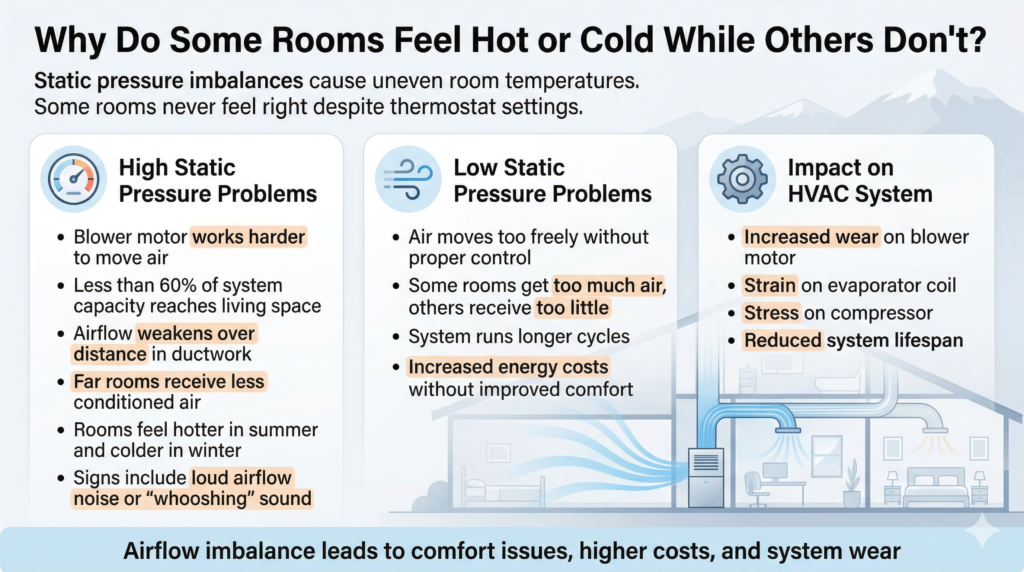
Why Do Some Rooms Feel Hot or Cold While Others Don’t?
Static pressure imbalances explain one of the most common comfort complaints homeowners bring to HVAC companies in Billings: some rooms never feel right, even though the thermostat says the system is working. Understanding why that happens helps you make sense of what a technician finds during a diagnostic visit.
High Static Pressure and Uneven Temperatures
When static pressure climbs too high, the blower motor must work much harder just to move the same amount of air. According to Home Energy Magazine, the average HVAC system delivers less than 60% of its rated capacity into the living space because of duct-related defects. That is a significant gap between what your system is designed to do and what it actually delivers.
The rooms that suffer most are typically the ones furthest from the air handler. Airflow is always strongest near the supply outlet. As resistance builds in the ductwork, the air loses momentum before it reaches distant bedrooms, finished basements, or rooms at the end of long duct runs. Those spaces end up colder in winter and hotter in summer than the rest of the home.
Expert Insight: “High pressure often sounds like a whooshing or jet engine noise coming from your vents or the furnace cabinet as the motor struggles to push air through tight spaces. When rooms are ice-cold while others stay warm, that is a classic sign that the air does not have enough push to reach the furthest points of the ductwork.” – Technical Team, Allied Air Conditioning and Heating (residential HVAC specialists)
Low Static Pressure Problems
Low static pressure is less common but equally disruptive. When there is not enough resistance in the system, air moves too freely and without proper distribution control. Some areas may receive too much conditioned air while others get too little. Your system may also run longer cycles trying to satisfy the thermostat, which drives up energy costs without improving comfort.
Both high and low static pressure increase wear on the blower motor, the evaporator coil, and the compressor. Left unaddressed, either condition shortens the useful life of your HVAC equipment significantly.
What Causes Static Pressure Problems in Billings Homes?
Several factors can push static pressure outside the healthy range. Montana winters put real demand on heating systems, and older homes in the Billings area often have ductwork that was sized for equipment from a different generation. Understanding the root causes helps you and your technician find the right solution faster.
Clogged or Dirty Air Filters
Dirty air filters are the single most common cause of high static pressure. A filter loaded with dust, pet dander, and debris acts like a wall that the blower must force air through. The more restricted the filter becomes, the harder the motor works and the less air reaches your living spaces.
Replacing filters on schedule is the simplest and least expensive step a homeowner can take to protect static pressure balance. Most systems need filter changes every one to three months depending on household conditions.
Undersized Ductwork or Return Vents
Ductwork that is too small for the system forces air through openings that cannot handle the volume. This is a design problem, not a maintenance problem. According to HVAC Know It All, an industry-focused technical resource, ductwork restriction shows up as high total external static pressure that does not change even after the filter and coil are cleaned. The system was simply installed with ducts that are too small for the blower.
Undersized return vents create the same problem from the opposite direction. The return side of your system pulls air back from your rooms so the blower can recondition and redistribute it. If those returns cannot move enough air, the entire system is fighting against itself.
Expert Insight: “What a lot of people do not understand is that installing an HVAC system is not like installing a wall-mount TV. It has to be engineered for the house, and every house is different. Ductwork that was sized for an older system may not be adequate for a newer, higher-efficiency unit.” – Forum Contributor, Heating Help: The Wall (certified HVAC engineer with 20+ years of residential system design experience)
Closed Vents and Blocked Return Grilles
A common myth is that closing vents in unused rooms saves energy. In reality, closing registers increases static pressure by blocking one of the pathways the blower was designed to use. Allied Air Conditioning and Heating notes that this forces the motor to work harder against a restricted path, raising pressure throughout the system.
Return grilles covered by furniture, curtains, or rugs have the same effect. The system cannot pull in the air it needs to recirculate, which creates an imbalance that shows up as hot and cold spots in other parts of the home.
Dirty Evaporator Coils
The evaporator coil inside your air handler is responsible for transferring heat between the refrigerant and the airflow. When dust and debris coat the coil surface, air has to squeeze through narrowed passages. This raises static pressure and increases energy consumption at the same time.
According to AirFixture, a manufacturer of commercial HVAC components, dirty coils force air through narrow passages, raising pressure and increasing energy use across the system. In Billings homes where heating seasons are long, coil buildup can happen faster than homeowners expect.
For professional help with your ductwork and airflow quality, Platinum HVAC offers trusted ductwork services to Billings and surrounding Montana communities.
How Does a Technician Perform Static Pressure Testing?
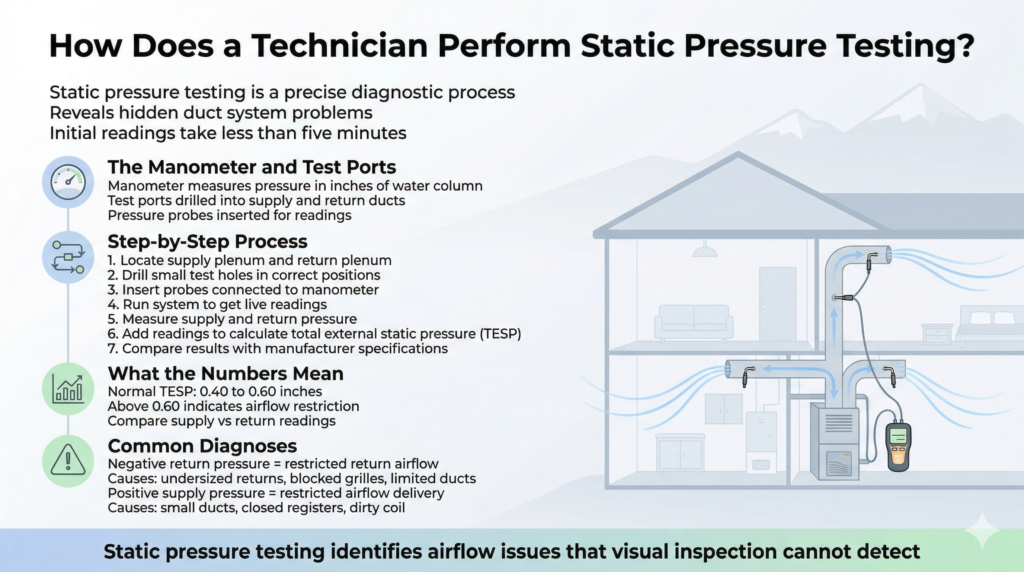
Static pressure testing is a precise diagnostic process that gives a technician a clear picture of what is happening inside your duct system. It takes less than five minutes to get the initial readings, but the interpretation of those readings can reveal problems that no visual inspection would ever catch.
The Manometer and Test Ports
The primary tool for static pressure testing is a manometer, a pressure-measuring device that reads in inches of water column. To take accurate readings, a technician drills small test ports into the supply and return sides of your ductwork, then inserts pressure probes through those ports.
Here is how the process works step by step:
- The technician locates the supply plenum (the main duct coming out of the air handler) and the return plenum (the main duct pulling air back in)
- Small test holes are drilled at the correct positions, keeping probes away from the coil, blower, and heat exchanger
- Pressure probes are inserted and connected to the manometer
- The system runs and the manometer displays live pressure readings on both the supply and return sides
- The technician adds those two readings together to calculate total external static pressure (TESP)
- That number is compared against the equipment manufacturer’s specifications and industry benchmarks
According to Level 9 HVAC, technicians measure pressure in two key locations during this process. Doing so allows them to pinpoint exactly where airflow resistance is occurring, rather than simply knowing that a problem exists.
What the Numbers Mean
According to HVAC Know It All, a normal total external static pressure reading on a residential system sits between 0.40 and 0.60 inches. When TESP climbs above 0.60 inches, the blower is working hard and efficiency is dropping. The diagnostic value comes not just from the total reading but from comparing the supply side to the return side.
A very negative return reading suggests the return air path is restricted, which points to undersized returns, blocked grilles, or too few return ducts. A very positive supply reading suggests restriction on the delivery side, which points to small ducts, closed registers, or a dirty coil.
For a full picture of how Platinum HVAC approaches HVAC diagnostics in Billings, our certified technicians combine static pressure testing with a comprehensive system evaluation.
What Happens If Static Pressure Problems Go Untreated?
Ignoring static pressure issues is one of the fastest paths to premature equipment failure. The consequences build over time and become more expensive the longer the underlying cause goes unaddressed.
Blower Motor Failure The blower motor is designed to operate within a specific pressure range. When static pressure stays elevated for months or years, the motor runs at higher speeds and temperatures than intended. This accelerated wear leads to early motor failure, one of the most common and costly HVAC repairs.
Cracked Heat Exchanger In Billings winters, restricted airflow caused by high static pressure can cause a furnace to overheat. Repeated overheating cycles can crack the heat exchanger, which creates a serious carbon monoxide risk for your household. This is a safety concern, not just a comfort issue.
Frozen Evaporator Coil When airflow across the evaporator coil is too slow due to high resistance, the coil temperature drops below freezing and ice forms on the surface. A frozen coil shuts down cooling entirely and can damage the compressor if it runs against a blocked coil for too long.
Higher Monthly Energy Bills According to Allied Air Conditioning and Heating, when the system fights against high resistance it stays on longer and uses more electricity to move the same amount of air. Homeowners often notice rising utility costs well before they connect those costs to a static pressure problem.
Short Cycling Your system may turn on and off rapidly as it hits internal temperature limits set by safety controls. Short cycling wears out components years ahead of schedule and prevents the system from completing full conditioning cycles, leaving rooms feeling inconsistently comfortable.
How Can Platinum HVAC Help Homeowners in Billings, MT?
At Platinum HVAC LLC, we approach every service call in Billings with the tools and training needed to find the real cause of your comfort problems. Static pressure testing is part of how our certified technicians evaluate system performance, not an extra charge or an optional step.
When you contact us about uneven temperatures, weak airflow, or rising energy bills, here is what our process looks like:
- We take static pressure readings at both the supply and return sides of your system
- We compare those readings against your equipment’s rated specifications
- We identify whether the problem is a filter, a coil, a duct design issue, or a blocked return
- We explain what we found in plain language before recommending any repairs
- We provide a clear solution that addresses the root cause, not just the symptoms
Whether your home needs a duct modification, a coil cleaning, or a return vent upgrade, our team has the experience to get your system performing the way it was designed to perform. Our system diagnostics in Billings are built around finding the root cause the first time.
Montana winters are long and demanding. A system with static pressure problems works harder every single day, costs more to operate, and wears out faster. Resolving those issues before a cold snap hits protects your equipment and your household budget.
For urgent comfort issues, learn more about our HVAC repair in Billings services, available when you need help most.
Schedule a Static Pressure Diagnostic in Billings Today
Uneven rooms are not just a comfort issue. They are a signal that your HVAC system is working harder than it should, delivering less than it is capable of, and wearing out faster than necessary.
Static pressure testing gives you and your technician the data needed to fix the actual problem, not just adjust the thermostat and hope for the best. At Platinum HVAC LLC, our certified technicians serve Billings and surrounding Montana communities with the diagnostic tools and technical expertise to get your system performing at full capacity.
If certain rooms in your home have never felt right, contact us today to schedule a visit. Our team is here to help you understand what is happening inside your system and to provide clear, dependable solutions that restore consistent comfort throughout your home.
Contact Platinum HVAC LLC to schedule your static pressure diagnostic in Billings, MT.
Frequently Asked Questions About Static Pressure Testing
What are the main signs that my home has a static pressure problem?
Static pressure imbalances typically show up as hot or cold spots in specific rooms, a whistling or rushing noise from vents or the furnace cabinet, an HVAC system that runs longer than normal, and rising monthly energy bills without a clear cause. If certain rooms never reach the temperature set on your thermostat, static pressure testing is a practical first step in diagnosing the problem.
Can I fix static pressure problems myself?
Some basic maintenance steps can help. Replacing a clogged air filter removes one of the most common causes of high static pressure immediately. Making sure return grilles are not blocked by furniture or curtains restores airflow on the return side. However, issues related to duct sizing, coil condition, or duct layout require a licensed technician with the proper tools to diagnose and correct safely.
How often should static pressure be tested?
Testing at every annual maintenance visit is the most reliable approach. A baseline reading taken when your system is running well gives your technician a reference point for future visits. According to PrimexVents, an HVAC ventilation manufacturer, static pressure should be measured whenever a new system is installed to create that baseline for future service calls.
Does closing vents in empty rooms help save energy?
No. Closing vents increases static pressure in the rest of the duct system, which forces the blower motor to work harder and can shorten equipment life. The energy you think you are saving gets consumed by the motor fighting against a more restricted system. Keeping vents open and clear in all rooms is the better approach for both efficiency and equipment health.
How do I choose the right HVAC company for a static pressure diagnostic in Billings?
Look for a company that uses calibrated manometers and drills actual test ports rather than estimating by feel or sound. A technician who takes readings at both the supply and return sides and explains the results before recommending repairs is demonstrating the kind of thorough diagnostic approach that protects your investment. For guidance on evaluating local contractors, see our resource on choosing the right HVAC company in Billings
Need a Billings HVAC technician today?
Platinum HVAC LLC is a family-owned, EPA-certified team serving Billings and Yellowstone County. We handle HVAC diagnostics in Billings, 24/7 emergency calls, and financing on new systems.
Call (406) 671-8446 or request service online.
Platinum HVAC LLC, 1478 S 30th St, Billings, MT 59102
Related guides