 Skip to content




Key Takeaways
- Proper AC sizing requires a Manual J load calculation, not a square footage guess. Oversized systems short-cycle, reduce humidity control, and wear out faster.
- Montana falls in the Northern region under federal SEER2 standards, meaning new AC installations must meet a minimum of 13.4 SEER2 as of January 2023.
- High-efficiency systems rated 17 SEER2 or above may qualify for a federal tax credit of up to $600 (30% of equipment cost).
- NorthWestern Energy offers residential efficiency rebates for Montana electric customers, with incentive amounts valid through June 30, 2026.
- A licensed HVAC contractor performs the full installation process: load calculation, equipment selection, refrigerant line set, electrical connection, and system commissioning.
AC installation in Billings involves three decisions that directly affect comfort, energy bills, and long-term system performance: sizing the unit correctly for your home, choosing the right SEER2 efficiency rating for Montana’s climate, and taking advantage of available rebates and tax credits to reduce your upfront cost. Getting all three right starts with working with a licensed HVAC contractor who runs a proper load calculation before recommending any equipment.
Why AC Installation Billings Requires a Proper Sizing Approach
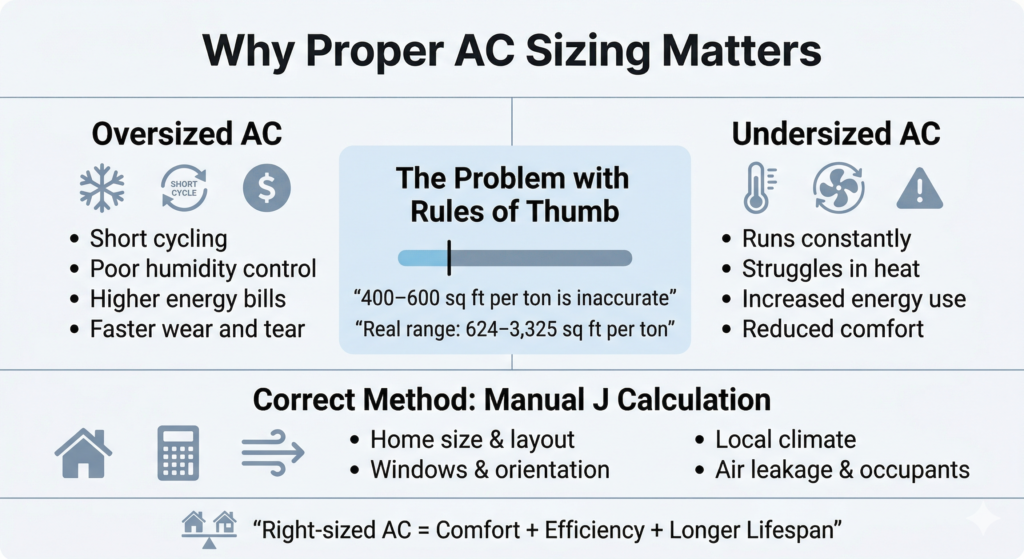
Sizing is the most important step in any AC installation in Billings. A system that is too large will cool the home quickly but shut off before completing a full cycle. A system that is too small runs constantly and still struggles on the hottest days. Both scenarios increase wear, drive up energy costs, and reduce equipment lifespan.
Many contractors still rely on outdated rules of thumb, such as “one ton of cooling per 400 to 600 square feet.” According to the Air Conditioning Contractors of America (ACCA), that rule of thumb routinely produces oversized equipment. Research published on the ACCA HVAC Blog analyzed 40 real-world Manual J load calculations and found cooling loads ranged from a low of 624 square feet per ton to a high of 3,325 square feet per ton. That is a massive range that a square footage shortcut cannot capture.
Expert Quote: “No matter the number, you can’t use square feet per ton to size air conditioners. Those results ranged from a low of 624 to a high of 3,325 sf/ton. You have to do an actual load calculation.” Allison Bailes, PhD, Building Science Educator and Founder, Energy Vanguard (ACCA HVAC Blog)
What Is a Manual J Load Calculation?
A Manual J load calculation is the industry-standard method for determining exactly how much cooling capacity a home requires. It was developed by ACCA and is required by most building codes for new equipment installations.
A proper Manual J assessment accounts for:
- Square footage and ceiling height of every conditioned room
- Insulation levels in walls, attic, and floors
- Window type, size, and orientation (south-facing windows without shading can add significant cooling load)
- Local design temperatures specific to Billings, MT
- Home airtightness and infiltration rates
- Number of occupants and internal heat-generating appliances
According to Energy Vanguard, a leading HVAC design research firm, most newer homes in cooler climates have cooling loads of 800 to 2,500 square feet per ton when calculated properly. That is two to five times less capacity than contractors using the 400-600 square feet per ton rule would install.
Why Oversized and Undersized Systems Both Hurt You
An oversized AC runs in short bursts rather than long, efficient cycles. This causes:
- Poor humidity control, leaving the air feeling damp and clammy
- More frequent on-off cycling, which accelerates compressor wear
- Uneven temperatures between rooms
- Higher energy bills due to inefficient start-up power draws
An undersized AC runs constantly on peak summer days but never fully cools the home. This causes:
- Elevated indoor temperatures during hot stretches
- Continuous motor wear from prolonged operation
- Higher utility costs from non-stop runtime
The goal is a system matched precisely to your home’s actual cooling load, not a rough estimate.
What Size AC Do You Need for Your Billings Home?
The correct size AC for a Billings home depends on a full Manual J load calculation performed by a licensed technician. That said, understanding the key factors that influence the result helps homeowners ask the right questions during a consultation.
Factors That Affect Cooling Load in Billings
Billings sits in a semi-arid, high-desert climate at approximately 3,100 feet of elevation. Summers bring warm days with low humidity and cooler evenings, which affects how hard an AC system works during peak afternoon hours. Key factors your contractor will evaluate include:
- Home age and insulation quality. Older homes in Billings often have thinner wall insulation and single-pane windows, both of which increase cooling demand. Well-insulated homes with modern windows may need 30% less capacity than a similar-sized but poorly insulated home, according to data cited in the ACCA’s Manual J methodology.
- Ductwork condition. A 12% duct leak can significantly inflate the effective cooling load, according to ACCA load calculation guidance, because conditioned air escapes before reaching living spaces.
- Window orientation. West-facing windows receive intense afternoon sun in Billings. South-facing windows without overhangs or shading can meaningfully increase cooling load.
- Ceiling height. Rooms with 10-foot ceilings require roughly 25% more cooling capacity than rooms with standard 8-foot ceilings, as the larger air volume must be conditioned.
- Number of occupants. Each person living in the home adds approximately 100 BTUs per hour to the cooling load.
Common Tonnage Ranges for Billings Homes
While only a Manual J calculation provides a reliable final number, the following general ranges apply to well-insulated homes in Billings’s climate zone:
| Home Size (Sq Ft) | Estimated Tonnage Range |
| 800 to 1,200 sq ft | 1.5 to 2 tons |
| 1,200 to 1,800 sq ft | 2 to 2.5 tons |
| 1,800 to 2,500 sq ft | 2.5 to 3.5 tons |
| 2,500 to 3,500 sq ft | 3.5 to 5 tons |
These are directional estimates only. Always confirm sizing with a professional load calculation before purchasing equipment.
What Is SEER2 and How Does It Apply to AC Installation in Billings?
SEER2 stands for Seasonal Energy Efficiency Ratio 2. It is the updated efficiency rating standard introduced by the U.S. Department of Energy, effective January 1, 2023. All new air conditioning equipment installed in the United States must carry a SEER2 rating rather than the older SEER rating.
The “2” matters because the testing methodology changed. SEER2 uses stricter real-world duct pressure conditions during testing, which produces ratings that are roughly 4 to 7% lower than equivalent units rated under the old SEER standard. A unit that earned a 14 SEER rating under the old system may only score 13.1 or 13.2 SEER2 under the new testing protocol.
Expert Quote: “A unit rated 14 SEER under the old system might only achieve 12 or 13 SEER2 under the new testing. Don’t panic if the numbers look lower. Same equipment, stricter measurement.” Budget Heating and Air Conditioning, 2026 Air Conditioner Buying Guide
SEER2 vs. the Old SEER Rating
| Feature | Old SEER | New SEER2 |
| Testing standard | M1 basic static pressure | Stricter M1 elevated static |
| Real-world accuracy | Lower (lab conditions) | Higher (field conditions) |
| Effective since | Pre-2023 | January 1, 2023 |
| Comparable conversion | 14 SEER = approx. 13.1-13.2 SEER2 | Always compare SEER2 to SEER2 |
When comparing systems or getting quotes in Billings, always verify that contractors are quoting SEER2 numbers. Mixing old SEER and new SEER2 ratings when comparing systems will produce inaccurate efficiency comparisons.
What Is the Minimum SEER2 Requirement in Montana?
Montana is classified in the Northern region under the Department of Energy’s regional efficiency standards. As of January 1, 2023, all new residential split-system AC installations in Northern states, including Montana, must meet a minimum efficiency of 13.4 SEER2, according to HVACDirect’s regional SEER2 standards guide.
Packaged units (where the entire system is housed in one outdoor cabinet) must meet a minimum of 13.4 SEER2 as well. Heat pump systems sold in the Northern region face a slightly higher baseline of 14.3 SEER2 and 7.5 HSPF2 for the heating side.
Any contractor installing equipment below these thresholds is not in compliance with federal law. Always confirm that your new AC unit’s SEER2 rating meets or exceeds the 13.4 SEER2 minimum before installation.
What SEER2 Rating Should Billings Homeowners Choose?
The minimum 13.4 SEER2 gets you legal compliance. It does not necessarily get you the best long-term value. Billings homeowners have shorter cooling seasons than southern states, which affects how quickly a higher-efficiency system pays back its upfront cost premium.
Mid-Efficiency vs. High-Efficiency: What Makes Sense in Montana’s Climate?
According to HVAC efficiency analysis from HVAC Calculator Hub, a 15 to 17 SEER2 system offers the best balance of upfront cost, energy savings, and features for most homeowners in moderate cooling climates. You save 25 to 35% on cooling costs compared to a minimum-efficiency unit without paying the premium price of 20-plus SEER2 systems.
Here is a general comparison for Billings homeowners:
| SEER2 Range | Best For | Notes |
| 13.4 SEER2 (minimum) | Budget-focused replacement | Legal minimum, lowest upfront cost |
| 15 to 17 SEER2 | Most Billings homeowners | Best cost-efficiency balance |
| 17 SEER2 and above | Tax credit seekers, longer-term owners | Qualifies for federal tax credit |
| 20-plus SEER2 | High-efficiency priority buyers | Longer payback period in short cooling seasons |
Expert Quote: “For most homeowners, 15-17 SEER2 offers the best balance of upfront cost, energy savings, and features. You’ll save 25-35% on cooling costs compared to minimum efficiency without the premium price of 20+ SEER systems.” HVAC Calculator Hub, Understanding SEER Ratings: Complete 2025 Guide
One important note: a 24 SEER2 system uses approximately 40% less electricity than a 14 SEER2 system, according to efficiency analysis by Zone Air. Over a 15-year lifespan, that difference translates to $1,200 to $1,350 in cumulative savings. In Billings, where the AC season runs roughly 3 to 4 months, the payback period is longer than in warmer climates, so the 17 to 19 SEER2 range tends to hit the sweet spot.
For homeowners replacing both a furnace and AC at the same time, choosing a compatible high-efficiency system combination can also open additional incentive opportunities. Learn more about how replacing your furnace and AC together may save money on combined installation costs.
What Rebates and Tax Credits Are Available for AC Installation in Billings?
Several financial incentives can reduce the out-of-pocket cost of a new AC installation in Billings. These include programs from NorthWestern Energy, the Montana Department of Environmental Quality, and the federal Inflation Reduction Act. Rebate availability and amounts are subject to change, so confirm current eligibility with your contractor or utility provider before purchasing equipment.
NorthWestern Energy Efficiency Rebates
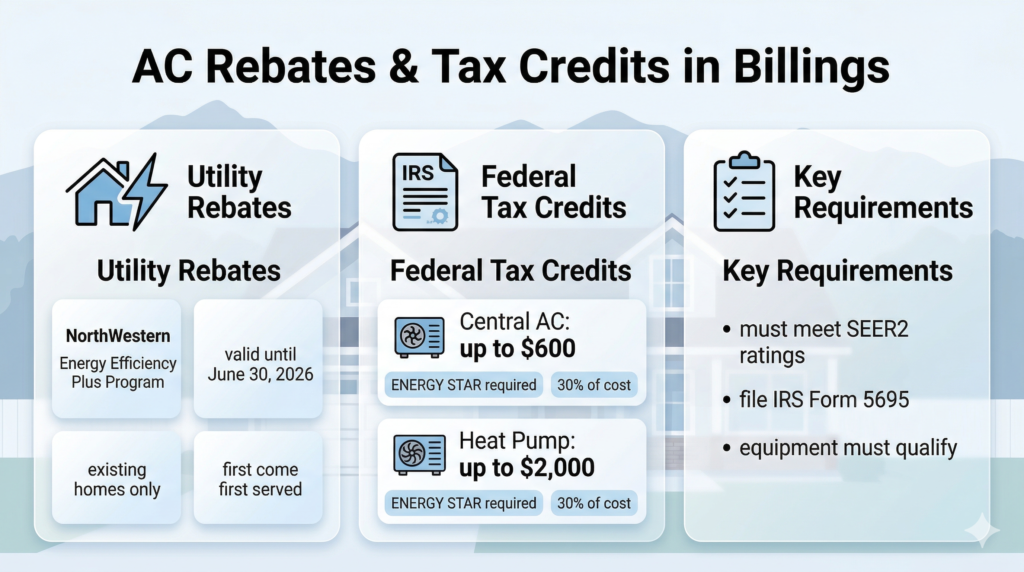
NorthWestern Energy, the primary electric utility serving Billings and much of Montana, offers rebates and incentives through its Efficiency Plus (E+) Program for residential electric customers. According to NorthWestern Energy’s rebates and incentives page, programs are available for both electric and natural gas customers, covering qualifying energy-efficient equipment installations.
Key program details based on current documentation:
- Incentive amounts are valid through June 30, 2026
- Projects must be completed and submitted by the June 30, 2026 deadline
- Work completed or materials purchased prior to August 1, 2025 are not eligible under the current program
- New construction does not qualify; the program applies to existing homes
- Funds are available on a first-come, first-served basis
- NorthWestern Energy representatives may verify completed jobs prior to payment, and payment is issued within 4 to 6 weeks of verified completion
Contact NorthWestern Energy directly at northwesternenergy.com/billing-payment/ways-to-save/rebates-incentives or call their customer service line to confirm current rebate amounts for specific equipment before purchasing.
Montana electric co-op members may also have rebate programs through their individual cooperatives. If you receive power from a co-op rather than NorthWestern Energy, visit your co-op’s website to check available incentives, as noted by the Montana DEQ Home Energy Rebates Program.
Federal Tax Credits for High-Efficiency Systems
The Inflation Reduction Act created federal tax credits for qualifying HVAC equipment. Based on guidance from Budget Heating and Air Conditioning’s 2026 buying guide, the following credits apply to systems installed in eligible homes:
Central Air Conditioner Tax Credit:
- Up to $600 (30% of equipment and installation cost, capped at $600)
- Requires SEER2 rating of at least 17.0 SEER2 and 12.0 EER2 for split systems
- Equipment must be ENERGY STAR certified
- Applies to your principal residence
Heat Pump Tax Credit:
- Up to $2,000 (30% of cost, capped at $2,000)
- Ducted heat pump systems require SEER2 of at least 15.2, HSPF2 of at least 8.1, and EER2 of at least 10
- Must meet ENERGY STAR Most Efficient criteria
To claim these credits, file IRS Form 5695 with your tax return. You will also need the manufacturer’s Qualified Manufacturer Identification Number (QMID) or QM code beginning in 2025. Consult a tax professional for guidance on your specific situation.
For Billings homeowners who want to invest in a high-efficiency system but need help managing the upfront cost, explore HVAC financing options that make installation more manageable while still capturing rebate and tax credit benefits.
What Happens During a Professional AC Installation in Billings?
Understanding the installation process helps you set expectations and ask the right questions when getting quotes. A proper AC installation in Billings is not just swapping one outdoor unit for another. It involves a series of steps that determine whether your new system operates at its rated efficiency.
Steps in the AC Installation Process
A licensed HVAC contractor from a company like Platinum HVAC will follow this process:
- Manual J load calculation. Before any equipment is ordered, a technician performs a room-by-room cooling load calculation to determine the correct system size. This step is the foundation of a quality installation.
- Equipment selection. Based on the load calculation results and your efficiency goals, your contractor recommends a matched system: outdoor condenser unit, indoor air handler or evaporator coil, and compatible components.
- Removal of old equipment. The existing outdoor condenser and indoor components are safely disconnected and removed. Old refrigerant must be recovered by a certified technician under EPA regulations.
- Installation of new outdoor condenser. The new unit is placed on a level pad, secured, and connected to the refrigerant line set and electrical supply.
- Indoor component installation. The evaporator coil or air handler is installed and connected to the ductwork system.
- Refrigerant line set connection. New refrigerant lines are run between the outdoor and indoor units, brazed and pressure-tested for leaks. As of January 2025, new systems use low-GWP refrigerants such as R-32 or R-454B rather than the now-phased-out R-410A.
- Electrical connections. The system is wired to the electrical panel with correctly rated breakers and disconnect switches.
- System startup and commissioning. The contractor charges the system with refrigerant, verifies operating pressures and temperatures, checks airflow, and confirms the thermostat is communicating correctly.
- Final walkthrough. A quality contractor walks you through thermostat settings, filter replacement schedules, and what to expect from the system’s operation.
When comparing quotes, verify that each contractor plans to perform a load calculation as part of their process. Contractors who offer a quote over the phone without visiting the home are likely using square footage rules of thumb rather than proper sizing methodology. Learn more about how to choose the right HVAC contractor in Billings before committing to an installation.
After your installation is complete, protect your investment with regular AC maintenance in Billings to keep the system running at peak efficiency and catch small issues before they become costly repairs.
Ready to Schedule Your AC Installation in Billings?
A properly sized, correctly installed AC system matched to your home’s actual cooling load is the single biggest factor in long-term comfort and energy savings. In Billings, that means a contractor who runs a Manual J calculation, installs equipment that meets or exceeds the 13.4 SEER2 Northern region minimum, and helps you navigate available rebates from NorthWestern Energy and federal tax credits before you finalize your equipment choice.
At Platinum HVAC LLC, our licensed technicians serve Billings and surrounding Montana communities with dependable AC installation, sizing consultations, and energy-efficiency guidance. We are available 24/7 and take the time to do the job right from load calculation to final commissioning.
Contact us today to schedule your AC installation consultation. If you have questions about our full range of cooling services in Billings, our team is ready to help.