 Skip to content



Key Takeaways:
- A furnace older than 15 to 20 years that needs frequent repairs is typically a better candidate for replacement than continued service calls.
- Repair costs exceeding 50% of a new furnace’s price signal that replacement is the smarter financial move.
- Rising energy bills, uneven heating, and strange noises are common signs your furnace is losing efficiency and reliability.
- Old furnaces operate at AFUE ratings as low as 56%, while modern systems achieve 90% to 98.5%, saving hundreds per year.
- Safety risks increase with age, especially carbon monoxide exposure from cracked heat exchangers.
A Billings furnace more than 15 years old that requires repeated repairs is likely too old to keep fixing. The clearest signs include rising heating bills, frequent breakdowns, uneven temperatures, unusual noises, and yellow burner flames. When repair costs approach 50% of a new furnace’s price, replacement is the more reliable and cost-effective choice.
Billings winters demand a dependable heating system. With temperatures regularly dropping well below freezing from November through March, your furnace works harder than systems in milder climates. Understanding when your furnace has crossed the line from “worth repairing” to “time to replace” can save you money, improve your comfort, and protect your family’s safety.
How Long Should a Furnace Last in Billings, Montana?
The average gas furnace lasts between 15 and 20 years with proper maintenance. High-efficiency models with modulating burners can push closer to 20 to 22 years when serviced regularly. However, lifespan depends on installation quality, maintenance history, and local climate.
What Affects Furnace Lifespan in Montana’s Climate?
Montana’s harsh winters put extra stress on heating systems. Furnaces in colder climates run longer cycles, increasing wear on the blower motor, heat exchanger, and electrical components. Key factors that influence furnace lifespan in Billings include:
- Maintenance frequency: Furnaces that receive annual professional tune-ups last longer and run more efficiently.
- System sizing: An oversized furnace short-cycles, while an undersized unit runs constantly. Both shorten the system’s life.
- Ductwork condition: The U.S. Department of Energy notes that leaky ductwork in unconditioned areas can lose up to 30% of the furnace’s energy output.
- Air filter maintenance: Clogged filters restrict airflow and cause overheating.
What Are the Warning Signs Your Furnace Needs Replacement?
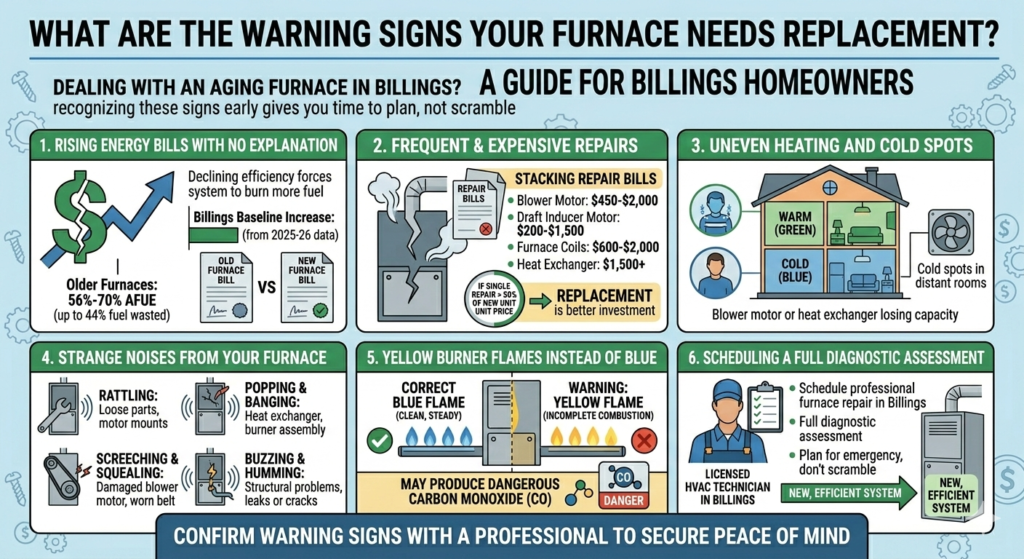
Billings homeowners dealing with an aging furnace should watch for several warning signs that the system is no longer worth repairing. Recognizing these signs early gives you time to plan rather than scramble during an emergency. If your furnace shows multiple symptoms from this list, schedule a professional furnace repair in Billings for a full diagnostic assessment.
Rising Energy Bills With No Explanation
A sudden or steady increase in heating bills, without a change in energy rates or usage habits, often points to declining furnace efficiency. Worn components force the system to burn more fuel to produce the same amount of heat.
According to the National Energy Assistance Directors Association, home heating costs rose 7.6% nationally for the 2025 to 2026 winter season. If your bills have increased well beyond that baseline, your furnace may be the problem. Older furnaces often operate at AFUE ratings as low as 56% to 70%, meaning up to 44% of your fuel is wasted.
Frequent and Expensive Repairs
One of the most obvious signs your Billings furnace is too old to keep repairing is a pattern of frequent breakdowns. If you are calling for service multiple times per heating season, those repair bills add up fast.
Furnace repair costs range widely depending on the component:
- Blower motor replacement: $450 to $2,000
- Draft inducer motor: $200 to $1,500
- Furnace coils: $600 to $2,000
- Heat exchanger: $1,500 or more
When repairs start stacking up, the total quickly approaches what you would spend on a new system. If a single repair costs more than 50% of a new furnace’s price, replacement is the better investment.
Uneven Heating and Cold Spots
A furnace that can no longer distribute heat evenly is struggling to meet demand. Cold spots in distant rooms or temperature differences between floors often signal that the blower motor or heat exchanger is losing capacity.
Strange Noises From Your Furnace
A healthy furnace operates quietly. New or worsening sounds often point to failing components:
- Rattling: Loose parts, deteriorating duct connections, or failing motor mounts
- Popping and banging: Problems with the heat exchanger or burner assembly
- Screeching or squealing: A damaged blower motor, worn belt, or failing bearings
- Buzzing or humming: Structural problems, including leaks or cracks in the furnace housing
Occasional minor sounds during startup are normal. Persistent or loud noises that worsen over time indicate components that are wearing out and may fail completely.
Yellow Burner Flames Instead of Blue
A properly functioning gas furnace produces a clean, steady blue flame. Yellow or orange flames from the burners indicate incomplete combustion, which means the furnace may be producing carbon monoxide. Carbon monoxide is odorless and colorless, making it extremely dangerous. If you see yellow flames, turn off the furnace and contact a licensed technician immediately.
When Does Repairing a Furnace Cost More Than Replacing It?
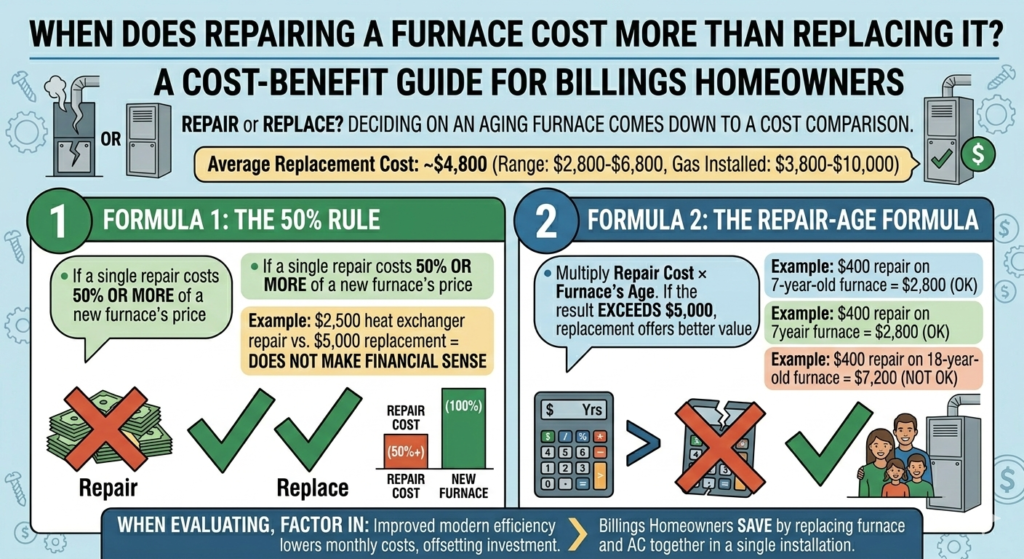
Deciding between repairing and replacing an aging furnace comes down to a cost comparison. The average cost to replace a furnace is approximately $4,800, with most homeowners spending between $2,800 and $6,800. Gas furnaces specifically range from $3,800 to $10,000 installed.
Two practical formulas help Billings homeowners make this decision:
- The 50% Rule: If a single repair costs 50% or more of a new furnace’s price, replacement is the better choice. A $2,500 heat exchanger repair on a system that costs $5,000 to replace does not make financial sense.
- The Repair-Age Formula: Multiply the repair cost by the furnace’s age. If the result exceeds $5,000, replacement offers better value. A $400 repair on a 7-year-old furnace ($2,800) is reasonable. The same repair on an 18-year-old furnace ($7,200) is not.
When evaluating these numbers, factor in the improved efficiency of a new system. A modern furnace lowers your monthly heating costs, which offsets the upfront investment over time. Many Billings homeowners also save by replacing their furnace and AC together in a single installation.
How Much More Efficient Is a New Furnace Compared to an Old One?
Furnace efficiency is measured by its AFUE (Annual Fuel Utilization Efficiency) rating, which represents the percentage of fuel converted into usable heat. The U.S. Department of Energy has gradually increased minimum AFUE standards to encourage energy savings.
Here is how older furnaces compare to modern systems:
| Furnace Age/Type | Typical AFUE Rating | Fuel Wasted Per Dollar |
|---|---|---|
| 25+ years old | 56% to 70% | $0.30 to $0.44 |
| 15 to 20 years old | 78% to 80% | $0.20 to $0.22 |
| Modern standard efficiency | 80% to 89% | $0.11 to $0.20 |
| Modern high efficiency | 90% to 98.5% | $0.02 to $0.10 |
The difference is substantial. Upgrading from an older 80% AFUE furnace to a modern 96% AFUE system can save approximately $200 to $400 annually on heating bills. Over a 15-year lifespan, those savings exceed $3,000.
New DOE standards finalized in 2023 will require a minimum AFUE of 95% for residential gas furnaces once the rule takes effect in 2028. Today’s high-efficiency furnaces already meet these future standards, making them a forward-looking investment for Billings homeowners.
A licensed technician can perform an HVAC diagnostics service to measure your current furnace’s operating efficiency and help you calculate potential savings from a new system.
Is an Old Gas Furnace a Safety Risk?
An aging gas furnace presents real safety concerns, particularly carbon monoxide exposure. Over time, the heat exchanger can develop cracks that allow combustion gases to mix with the air circulating through your home.
Key safety concerns with older gas furnaces include:
- Cracked heat exchanger: Allows carbon monoxide to enter your home’s air supply. Replacement costs typically exceed $1,500, and on an older furnace, this repair rarely makes financial sense.
- Failing gas valve: Can lead to gas leaks that create fire and explosion risks.
- Deteriorating flue connections: Corroded flue pipes may vent exhaust gases into your home instead of outside.
- Outdated safety controls: Older furnaces lack modern safety features like electronic flame sensors and automatic shutoff systems.
If your furnace is more than 15 years old, install carbon monoxide detectors on every level of your home. Schedule annual safety inspections with a licensed HVAC technician to check for cracks, leaks, and proper venting.
What Should Billings Homeowners Do Next?
If your Billings furnace is showing one or more of these warning signs, taking action now can save you from an unexpected breakdown during Montana’s coldest months:
- Schedule a professional inspection. A licensed technician can evaluate your furnace’s condition, measure its efficiency, and identify components at risk of failure.
- Request a repair-versus-replacement estimate. Get the cost of needed repairs alongside the cost of a new professional furnace installation. Having both numbers makes the decision clear.
- Compare efficiency ratings. If your current furnace has an AFUE below 80%, a modern high-efficiency system will pay for itself over time.
- Plan before winter peaks. Scheduling replacement during fall or early spring saves money and avoids emergency wait times.
Platinum HVAC LLC provides honest, dependable furnace diagnostics and replacement services for homeowners throughout Billings, MT and surrounding communities. Our licensed technicians will walk you through your options and help you choose the right system for your home and budget. Contact us today to schedule a service visit.