



Key Takeaways
- Manual J is the ANSI-recognized industry standard for calculating exactly how much heating and cooling your home needs, measured in BTUs
- Manual S uses those results to select the right HVAC equipment, preventing oversizing and undersizing
- Manual D designs your duct system so every room receives its correct share of conditioned air
- Oversized HVAC systems short cycle, wasting 20-30% more energy and cutting equipment lifespan nearly in half
- Asking your Billings HVAC contractor for a Manual J report before any installation is one of the smartest steps a homeowner can take
Manual J, Manual S, and Manual D are the three ACCA-recognized standards that guide proper HVAC system design for residential homes. Manual J calculates your home’s true heating and cooling load in BTUs. Manual S uses those numbers to select correctly matched equipment. Manual D designs the duct system to deliver conditioned air evenly to every room. Together, these three calculations ensure your system is sized right, runs efficiently, and keeps every part of your home comfortable year-round.
Why HVAC Sizing Matters More Than Most Billings Homeowners Realize
Most homeowners assume HVAC sizing is simple. Bigger square footage means bigger unit, right? That thinking has resulted in roughly half of all residential HVAC systems being improperly sized, according to industry estimates from Fire and Ice HVAC. About one in four units is oversized, meaning it runs too hard, too fast, and too briefly to do its job properly.
Montana’s climate makes this especially important. Billings winters can push temperatures well below zero, and summers regularly climb into the 90s. A system that is even one ton too large or too small will struggle to manage both extremes effectively. Proper sizing starts with understanding what load calculations actually measure and why they exist.
“Equipment size is one of the most common and crippling problems of all. Simply put, your HVAC system needs to be the right size for your home. Otherwise, it won’t keep you comfortable. And performing a Manual J load calculation is the only way to determine which size is the right size.” Jason Peavey, Co-Founder and Director of Sales and Marketing, PV Heating, Cooling and Plumbing; 2024 recipient of the Conditioned Air Association of Georgia’s “20 Under 40” award
The Real Cost of an Oversized System
An oversized HVAC system short cycles, meaning it turns on, blasts air to the thermostat sensor quickly, and shuts off before the rest of your home reaches the target temperature. Research consistently shows that short cycling increases energy costs by 20 to 30 percent compared to properly operating equipment.
The mechanical damage is even more significant. A normal HVAC system starts and stops 6 to 8 times per day. A short cycling system may start and stop 30 to 50 times daily, representing 400 to 600 percent more wear on the compressor, contactor, and blower motor. Normal HVAC lifespan is 15 to 20 years. Oversized systems that short cycle regularly tend to fail at 8 to 10 years, cutting expected lifespan nearly in half, according to ProCalcs.
Short cycling also strips away humidity control. Air conditioning removes moisture only when the evaporator coil stays cold long enough for condensation to collect and drain. A system that shuts off too quickly never completes that process, leaving your home feeling cold but clammy.
What Happens When a System Is Too Small
Undersizing creates the opposite problem. The system runs continuously, never quite reaching the set temperature during extreme weather. This constant full-load operation accelerates motor wear, drives up energy bills, and leaves parts of the home consistently uncomfortable. Neither outcome, oversized or undersized, delivers the comfort or efficiency a homeowner expects from a new HVAC installation.
What Is Manual J? The Foundation of Every HVAC Installation
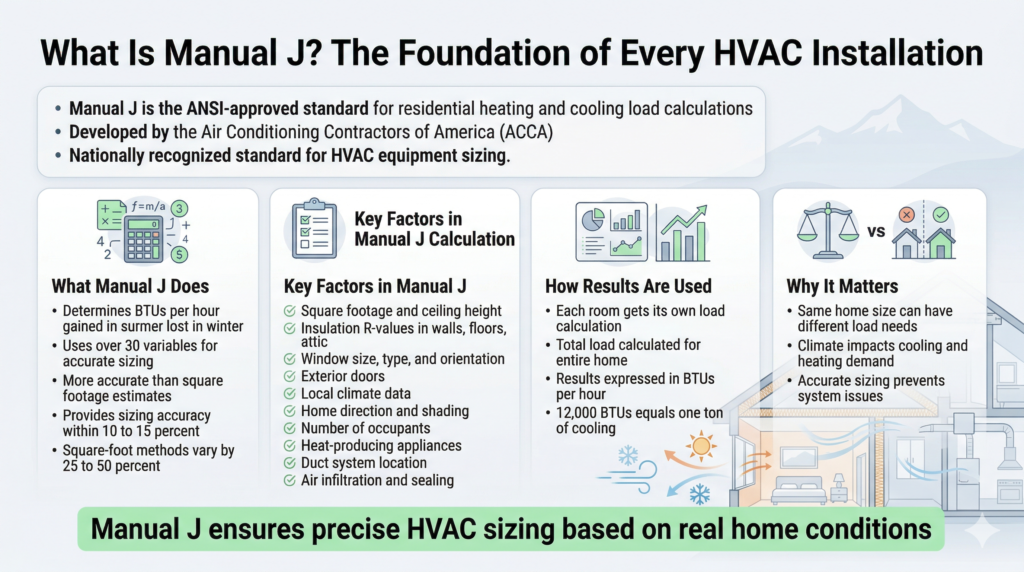
Manual J is the ANSI-approved standard for residential heating and cooling load calculations, developed by the Air Conditioning Contractors of America (ACCA). According to ACCA, Manual J 8th Edition is the nationally recognized standard for producing HVAC equipment sizing loads for single-family homes, condominiums, townhouses, small multi-unit structures, and manufactured homes.
In plain terms, Manual J tells your HVAC contractor exactly how many BTUs per hour your home gains in summer heat and loses in winter cold. Unlike the old rule-of-thumb method that guesses based on square footage alone, Manual J accounts for more than 30 variables that influence your home’s actual heating and cooling demand.
“Manual J is the only procedure recognized by ANSI and specifically required by residential building codes. Methods not based on actual construction details, nor founded on relevant physical laws and engineering principles, are unlikely to result in correct equipment sizing.” Air Conditioning Contractors of America (ACCA), Manual J 8th Edition Technical Documentation
Manual J calculations provide sizing accuracy within 10 to 15 percent of your home’s true load, compared to 25 to 50 percent variance when using simplified square-footage methods, according to SolarTech Online.
What Factors Go Into a Manual J Calculation?
A certified HVAC technician or designer inputs specific data about your home into ACCA-approved software to complete a Manual J. The key factors include:
- Square footage and ceiling height of every room in the home
- Insulation R-values in walls, floors, and attic or ceiling
- Number, size, type, and orientation of windows (a west-facing window gains significantly more solar heat than a north-facing one)
- Number and type of exterior doors
- Local climate data including outdoor design temperatures for Billings, MT
- Direction the home faces and how much shade surrounds it
- Number of regular occupants (each person generates approximately 250 BTUs per hour)
- Heat-producing appliances in the kitchen or laundry areas
- Duct system location (ducts in unconditioned attic space lose more energy than ducts inside the conditioned envelope)
- Air infiltration rates based on how tightly sealed the home is
Each room receives its own load result. The technician then totals those room-by-room figures to determine the whole-home heating and cooling load. That total, expressed in BTUs per hour, becomes the foundation for everything that follows.
What Does a Manual J Result Tell You?
A completed Manual J report gives two key numbers: total design heat loss (for winter) and total design heat gain (for summer). These numbers directly tell your HVAC designer how large the equipment needs to be. For reference, 12,000 BTUs equals one ton of cooling capacity.
A same-size home can have dramatically different load requirements depending on these variables. Research from SolarTech Online shows that a 2,500 square foot home may require 5.4 tons of cooling in Houston but only 3.5 tons in a cooler climate like Chicago or Billings. This is exactly why square footage alone is never a reliable guide for HVAC sizing.
What Is Manual S and Why Does Equipment Selection Matter?
Once a Manual J load calculation is complete, the next step is Manual S. According to ACCA and American National Standards Institute (ANSI), Manual S is the only ANSI-recognized procedure for residential equipment selection in the United States. It guides HVAC designers in matching the right heating and cooling equipment to the load numbers produced by Manual J.
This step matters more than most homeowners realize. Simply picking the closest “round number” in equipment tonnage without running Manual S can still result in a system that performs poorly, especially in terms of humidity control and latent heat removal.
“Oversized equipment generally requires larger ducts, increased electrical circuit sizing, and larger refrigeration tubing. These cause higher installed costs and increased operating expenses. The temperature may feel right at the thermostat, but the temperature in other rooms will suffer from short operation cycles.” Air Conditioning Contractors of America (ACCA), Manual S Equipment Selection Standard Documentation
How Manual S Differs from Just Picking a Unit by Tonnage
Manual S uses actual manufacturer performance data, called OEM data, rather than the standard AHRI ratings printed on equipment labels. AHRI ratings are tested at fixed outdoor and indoor conditions (95 degrees outdoor, 80 degrees indoor). Your home’s real conditions will rarely match those numbers exactly.
Manual S requires the equipment to be selected at the actual outdoor and indoor design conditions used in the Manual J calculation. For Billings, that means accounting for Montana’s specific climate data rather than a national average. The standard allows cooling equipment to be sized at 95 to 115 percent of the Design Total Heat Gain, and heating equipment to be sized at 100 to 140 percent of the Design Total Heat Loss.
Manual S also verifies:
- Total cooling capacity to handle both sensible (temperature) and latent (humidity) loads
- Airflow in CFM (cubic feet per minute) compatible with the selected equipment’s blower
- Heating output that meets the calculated heat loss without overshooting
- Equipment compatibility with the proposed duct system from Manual D
Many building permit offices and energy efficiency programs including Energy Star and LEED require Manual S documentation alongside Manual J before issuing permits for new HVAC installations.
What Is Manual D? How Your Ductwork Gets Designed
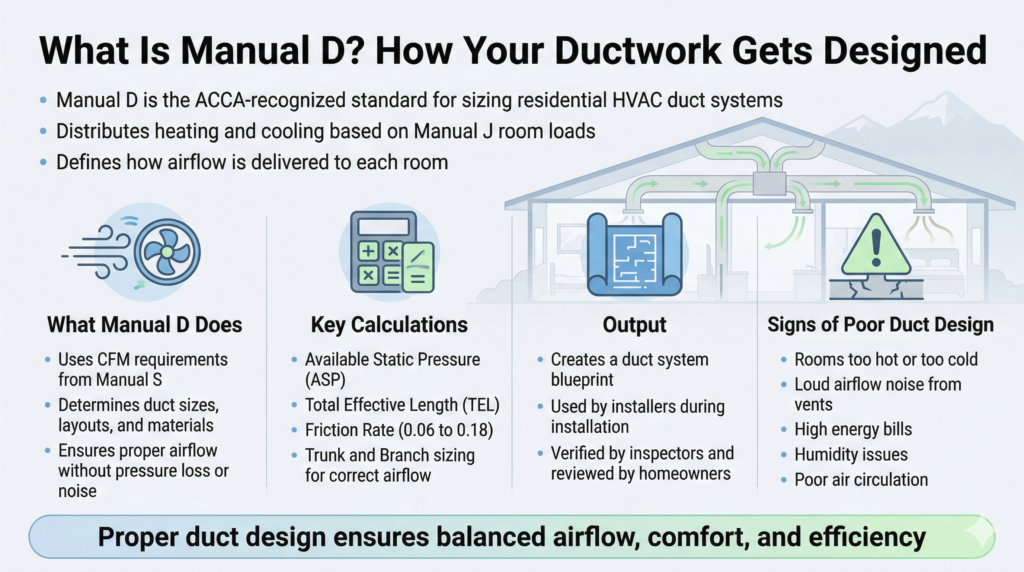
Manual D is the ACCA-recognized standard for sizing residential HVAC supply and return duct systems. As described by load-calculations.com, Manual D duct design distributes the correct amount of heating and cooling to each room based directly on the Manual J room-by-room load results.
If Manual J is the recipe and Manual S selects the ingredients, Manual D is the instruction for how to deliver every portion correctly to each room.
“Poor airflow remains the number one issue energy raters are finding as they test duct systems for EnergyStar and other above-code programs. The failure to correctly design and install the duct system is the single greatest issue with air conditioner performance.” Utah State Energy Code Program, ACCA Residential HVAC Standards Review
What Manual D Actually Calculates
A Manual D duct design takes the CFM (cubic feet per minute) requirements from Manual S and works backwards to determine what duct sizes, layouts, and materials will deliver that airflow to each room without excessive friction, pressure drop, or velocity noise.
Key calculations in Manual D include:
- Available Static Pressure (ASP) – The pressure the blower can generate minus all pressure losses from filters, coils, registers, and grilles
- Total Effective Length (TEL) – The longest supply run plus the longest return run, plus friction losses from all fittings, elbows, and transitions
- Friction Rate – Derived from ASP and TEL; per ACCA standards this value must fall between 0.06 and 0.18 to produce proper airflow
- Trunk and Branch Sizing – Individual duct diameters sized to carry the right CFM to each room without exceeding velocity limits that cause noise
A completed Manual D produces a duct blueprint that the installer follows on the job, that the homeowner can review, and that the building inspector can verify.
Signs Your Duct System Was Never Properly Designed
Many Billings homeowners live with duct systems that were never designed using Manual D. Common symptoms include:
- One or two rooms that are always hotter or colder than the rest of the house
- Noticeable air rushing noise from vents during system operation
- High energy bills despite a relatively new or efficient HVAC unit
- Humidity problems even after the AC has been running for a while
- Rooms that feel stuffy or have poor air circulation
If you recognize these signs, our professional HVAC diagnostics team can evaluate your existing duct system and identify whether a redesign would resolve the comfort issues you are experiencing.
Do You Really Need All Three Calculations?
Yes, and here is why each one depends on the one before it.
Manual J, Manual S, and Manual D are not independent options. They are a sequential system where each step feeds directly into the next. E-Calcs Plus describes them simply: Manual J focuses on the load calculation, Manual S guides equipment selection to meet those calculated demands, and Manual D helps in designing duct systems to deliver conditioned air effectively throughout the building.
Skipping any one step creates problems that the remaining steps cannot fix. For example:
- Running Manual S without Manual J means equipment is selected without knowing the actual load, which almost always results in oversizing
- Running Manual D without Manual S means duct design is based on assumed airflow numbers rather than verified blower performance data
- Skipping Manual D entirely and reusing old ductwork with a new system often creates airflow imbalances that the new equipment cannot overcome
The IECC 2024 energy code, which most jurisdictions are adopting, now codifies HVAC sizing per Manual S using building loads from Manual J, with Manual D duct layouts required as part of plan review, according to The Furnace Outlet’s energy code analysis. Many Montana permit offices require all three calculation reports before issuing an HVAC installation permit.
How Do I Know If My Contractor Followed These Standards?
This is one of the most important questions a Billings homeowner can ask before any HVAC installation or replacement. Unfortunately, research cited in Contracting Business magazine shows that slightly fewer than half of HVAC contractors perform comprehensive load calculations. Many use outdated square-footage rules or simply match the size of whatever unit they are replacing.
“Studies from the Department of Energy and my own conclusions from talking to HVAC contractors while teaching courses on Manual J show that slightly less than half of them do comprehensive load calculations. Instead, many HVAC contractors use inconsistent methods or guesswork, which can result in poor system performance.” Rob Falke, President, National Comfort Institute; HVAC educator and industry trainer, writing in Contracting Business
Questions to Ask Before Any HVAC Installation
When you are choosing the right Billings HVAC company for a new installation or system replacement, these questions will quickly reveal whether a contractor takes proper sizing seriously:
- Will you perform a Manual J load calculation before recommending equipment? Any contractor who answers no or seems unfamiliar with the term is using guesswork.
- Can I receive a printed or PDF copy of the Manual J report? Legitimate calculations produce a detailed report. Ask to see it.
- What software do you use for load calculations? ACCA-approved platforms include Wrightsoft, Elite RHVAC, and Cool Calc. These have a verified track record.
- Will you complete a Manual S equipment selection and Manual D duct design? A contractor doing all three is following best practices.
- Has anything changed in my home since the last system was installed? Insulation upgrades, window replacements, additions, or occupancy changes all affect load calculations and may mean your previous system was already the wrong size.
Keep in mind that if you are replacing a system that was installed without these calculations, the replacement may well be a different size than the original. This is not a sign of a problem; it is often a sign that the new contractor is doing the job correctly.
Platinum HVAC Follows the Right Process in Billings, MT
At Platinum HVAC LLC, every installation and replacement begins with a proper load calculation. We do not guess, we do not use outdated rules of thumb, and we do not simply match the size of the unit we are replacing. Our licensed technicians perform Manual J calculations using ACCA-approved software specific to Billings, MT climate data before we recommend any equipment.
Whether you are considering a furnace installation in Billings, evaluating a heat pump, or thinking about replacing your furnace and AC together, the right starting point is always an accurate load calculation. Getting the size right the first time means years of reliable comfort, lower energy bills, and a system that lasts as long as it should.
If you have been experiencing hot and cold spots, higher-than-expected energy bills, or humidity issues, our residential HVAC services in Billings include a full diagnostic review that can identify whether improper sizing or poor duct design is the root of your comfort problems.
Contact Platinum HVAC today to schedule a consultation. Our team is ready to walk you through the load calculation process in plain language and make sure your next HVAC system is sized correctly for your home and for Billings, Montana’s climate.