



Key Takeaways
- Manufacturer parts warranties cover replacement components that fail due to manufacturing defects. Most brands offer 5 years standard, extending to 10 years with timely product registration. Heat exchangers are typically covered for 20 years.
- Labor warranties cover the technician’s time to diagnose and install replacement parts. Manufacturers almost never include labor. This coverage comes from your installer, a third-party plan, or an optional extended warranty.
- Without labor coverage, a warranty-covered repair can still cost $150 to $400+ in labor alone. Understanding both sides of your warranty prevents surprise bills during Billings’ coldest months.
Your furnace warranty has two separate components that work differently, come from different sources, and protect you in different ways. Most Billings homeowners assume their warranty covers everything if something breaks, but that is rarely the case. Platinum HVAC explains how parts and labor coverage actually work so you can make informed decisions about protecting your furnace investment.
What Does a Manufacturer Parts Warranty Cover?
Every new furnace comes with a manufacturer’s limited warranty that covers the cost of replacement parts if a component fails due to a manufacturing defect. This is the warranty that comes standard from brands like Trane, Carrier, Lennox, Goodman, and others.
A typical manufacturer parts warranty covers the heat exchanger, blower motor, gas valve, control board, ignitor, flame sensor, inducer motor, and other internal functional parts. If any of these components fail because of a factory defect during the warranty period, the manufacturer provides the replacement part at no cost.
There is an important catch. According to Trane’s warranty documentation, a parts warranty only covers the component itself. It does not cover the labor required to remove the failed part and install the new one, nor does it cover shipping, diagnostic fees, or refrigerant.
Most manufacturers structure their parts warranty in two tiers. The base warranty (typically 5 years on parts, 20 years on the heat exchanger) applies automatically. The registered warranty (typically 10 years on parts, 20 years on the heat exchanger) activates only when you register the furnace within 60 days of installation. Failing to register on time cuts your parts coverage in half with no way to recover it.
What Does a Labor Warranty Cover?
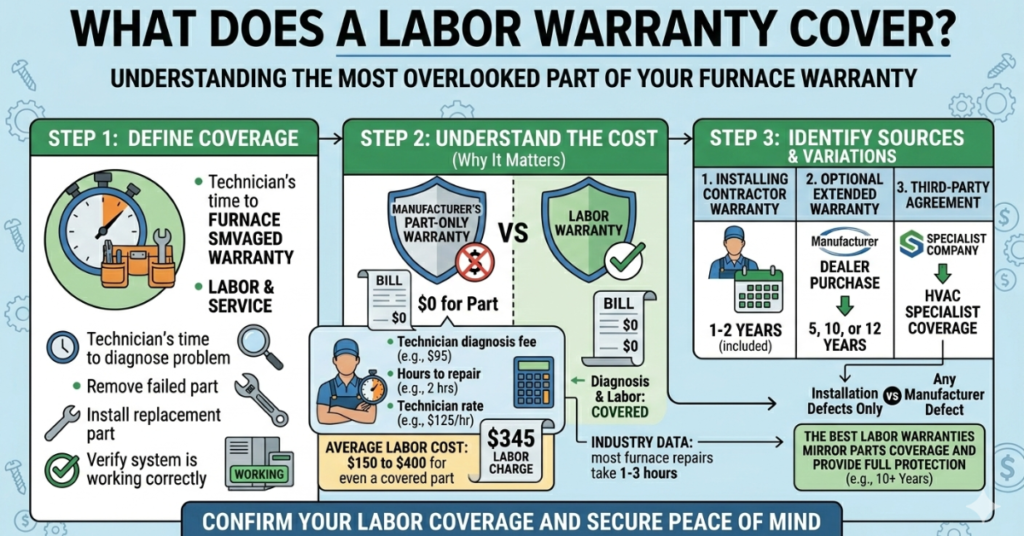
A labor warranty covers the technician’s time and service charges to diagnose the problem, remove the failed part, install the replacement, and verify the system is working correctly. This is the piece most homeowners overlook when evaluating their furnace warranty.
Manufacturers almost never include labor in their standard or registered warranties. According to industry data, HVAC technicians charge $75 to $150 per hour, and most furnace repairs take one to three hours to complete. That means even a warranty-covered part can still result in a $150 to $400 bill for the labor alone.
Labor coverage comes from one of three sources. Your installing contractor may include a labor warranty with the installation (commonly 1 to 2 years, sometimes longer). A manufacturer’s optional extended warranty can be purchased through your dealer for 5, 10, or 12 years of parts-and-labor protection. A third-party extended service agreement through companies that specialize in HVAC coverage is another option some homeowners choose.
Not all labor warranties are equal. Some cover only repairs related to installation defects. Others cover any manufacturer-defect repair. The best labor warranties mirror the parts warranty period and cover the full cost of diagnosis, labor, and parts replacement for the duration of the agreement.
Why the Parts vs Labor Distinction Matters for Billings Homeowners
The gap between parts coverage and labor coverage becomes very real when your furnace breaks down during a Billings winter. Consider these common repair scenarios and what you would pay with and without labor coverage.
| Repair | Parts Cost | Labor Cost | With Parts Warranty Only | With Parts + Labor Warranty |
|---|---|---|---|---|
| Ignitor replacement | $30 to $60 | $120 to $200 | $120 to $200 | $0 |
| Flame sensor replacement | $15 to $50 | $75 to $150 | $75 to $150 | $0 |
| Blower motor replacement | $350 to $1,150 | $150 to $250 | $150 to $250 | $0 |
| Control board replacement | $200 to $600 | $150 to $300 | $150 to $300 | $0 |
| Heat exchanger replacement | $1,000 to $2,000 | $500 to $1,500 | $500 to $1,500 | $0 |
Source: Cost ranges based on HomeAdvisor 2025 national data. Billings labor rates may vary.
A heat exchanger replacement under parts-only warranty still leaves you paying $500 to $1,500 in labor because the technician must disassemble and reassemble the entire furnace to access the component. Without any warranty, that same repair can exceed $3,500 total.
How to Maximize Your Furnace Warranty Coverage
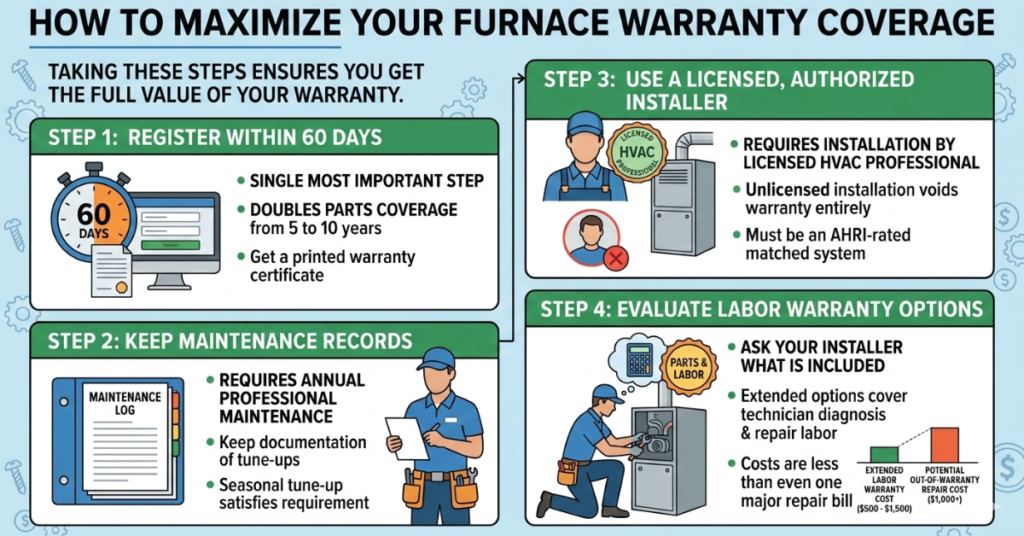
Taking a few steps at the time of installation and throughout the furnace’s life ensures you get the full value of your warranty.
Register within 60 days. This is the single most important step. Registration is free and doubles your parts coverage from 5 to 10 years. Your installer can handle this for you, but confirm it has been completed and request a printed warranty certificate. Platinum HVAC registers every furnace we install on behalf of our customers.
Keep maintenance records. Most manufacturers require annual professional maintenance to keep the warranty valid. If you file a claim, the manufacturer or their authorized service provider may ask for documentation that the furnace was properly maintained. A seasonal tune-up satisfies this requirement and catches problems early before they escalate.
Use a licensed, authorized installer. Furnace warranties require installation by a licensed HVAC professional. Installations performed by unlicensed individuals or homeowners void the warranty entirely. The system must also be part of an AHRI-rated matched system to qualify for full coverage.
Evaluate labor warranty options before installation. The best time to secure labor coverage is when the furnace is installed. Ask your installer what labor warranty is included and what extended options are available. Comparing the cost of a 10-year labor warranty ($500 to $1,500 in most markets) against the potential cost of even one major out-of-warranty repair often makes the extended coverage worthwhile.
Should You Buy an Extended Warranty for Your Billings Furnace?
Extended warranties that cover both parts and labor provide the most complete protection. Whether they make sense depends on your situation.
An extended warranty is a smart investment if you plan to stay in your home for 10 or more years, you want predictable repair costs with no surprise labor bills, your furnace is a higher-end model with more expensive components (variable-speed blower motors and modulating gas valves cost more to repair), or your home relies entirely on the furnace for heat with no backup source.
An extended warranty may be less necessary if you plan to sell within a few years (though the transferable warranty adds resale value), you are comfortable budgeting for potential repair costs, or your furnace is a straightforward single-stage model with widely available, lower-cost parts.
Most major brands, including Trane, offer extended warranties in 5, 10, or 12-year terms that cover parts and labor. These are purchased through your dealer at the time of installation. Some plans can also be added within the first two years of ownership.
What Voids a Furnace Warranty?
Understanding what voids your warranty is just as important as knowing what it covers. The most common warranty-voiding actions include failing to register the product within the required timeframe, skipping annual professional maintenance, having the system installed by an unlicensed contractor, using non-approved parts or modifications, and failing to file a warranty claim within 90 days of the failure date.
If your furnace was installed improperly and that installation caused the failure, the warranty does not apply regardless of registration status. This is one of the strongest reasons to choose an experienced, licensed HVAC company in Billings for your installation.
Protect Your Investment with Platinum HVAC
Platinum HVAC registers every furnace we install, provides detailed maintenance documentation, and offers labor warranty options so our Billings customers are fully protected. Whether you need a new furnace installation or want to verify the warranty status on your existing system, our team can help.
Contact Platinum HVAC today to schedule a consultation, or explore our heating services and AC maintenance plans to keep your warranty intact year after year.